
Law from the Bottom Upwards
How the Brehons held Ireland together
Daniel Donnelly
3/17/20265 min read
On a typical evening in cities like New York and Boston during Saint Patrick’s Day, one often confronts scenery far removed from the holiday’s origins. Any celebration of St. Patrick for having Christianized Ireland is long gone, supplanted by celebration of “Irishness” itself. In the best cases, this manifests as revelers enjoying Irish music, maybe sean nós dancing, and a wholesome meal of corned beef and cabbage with family and friends. In the worse cases – and obviously it depends where and how late you go – it manifests as surly fisticuffs outside a pub, tipsy couples snogging between parked cars, and frat brahs sporting green beads and bowlers drunkenly bellowing the Pogues’ “Dirty Old Town” as they carouse through littered streets.
Not that any one person or thing defines Irishness as a concept and identity, but against some of these less flattering representations, let me recount for you an aspect of Irish history and culture which gets none of the emphasis it deserves. It is the tale of how the Irish people handed the law up to their kings, rather than the kings down to them.
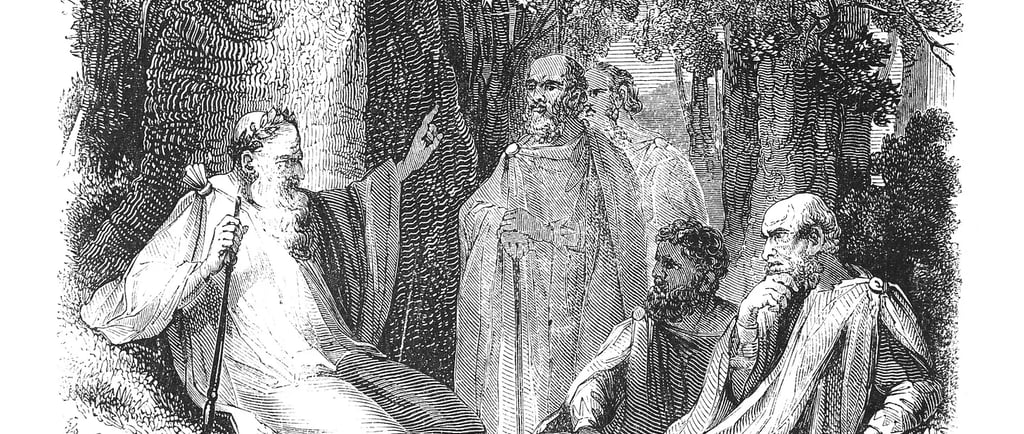
Gaelic society’s building block was the clan, that being parents, siblings, uncles, aunts, nieces, nephews and cousins, all tracing their descent from a common great- or even great-great-grandfather. A group of clans formed a tuath, in which 2000 - 3000 people lived. The tuath elected a chieftain called a rí to safeguard the tuath’s territory. The rí defended the tuath and maybe conducted offensive raids on neighboring tuatha, but generally the rí was not involved in enforcing the laws and meting out justice (Casey, 2012, Libertarian Anarchy, pp. 105-107). Justice was the people’s exclusive purview, guided by a breaitheamh meaning “judge” and anglicized as brehon.
The brehon was no judge in the modern sense but more like a mediator. He heard disputes and evaluated the claims against his extensive knowledge of the law. This was not positivist law enacted by legislators or decreed by the rí, but case law accumulated over centuries. A brehon’s training could take fifteen years during which he progressed through the “Seven Grades of Wisdom,” each corresponding to another level of mastery over wide-ranging jurisprudence and legal principles expressed through stories. The training’s rigors were such that few could progress to the upper grades, and certain clans became known for producing brehons, namely the Mac Aodhagáin (Egan), Mac an Bhaird (Ward) and Ó Dálaigh (Daly).
Since every offense or lapse harmed a real, identifiable person, the modern concept of criminal law – which impleads the legal fiction of the State as the aggrieved party – would have been inconceivable for the Gaels. Brehon law was thus civil in nature, and judgments always required restitution in payment or service. For more serious offenses like arson and murder, the payment required could be so high that the offender would be left destitute and may have to live indentured to the aggrieved clan until he could pay off his judgment (Kerrigan, 2020, Brehon Laws, p. 16).
When the brehon arrived at a judgment, he had to analogize the legal principles at work to some observable phenomenon in nature, which he pronounced as a poem or adage to the claimants. This was not mere romantic flourish but rather a practical way to make the judgment memorable to the case’s claimants. By way of example, in 561 A.D., Saint Finnian of Moville was custodian of the Gallicanum Psalter, which Colum Cille transcribed in secret. St. Finnian became aware of Cille’s transcription and demanded that Cille surrender it to him, but Cille refused since he believed that the psalms should be shared far and wide. A brehon mediated their case and sided with St. Finnian by enouncing, “To every cow belongs its calf, and to every book, its copy.”
This case preserves the mnemonic adage in judgment but otherwise is not the best illustration of brehon law working as intended. Colum Cille (later Saint Collum, who proselytized Scotland) disputed the judgment and mobilized his clan, the mighty Uí Néills, against St. Finnian’s. The result was the Battle of Cúl Dreimhne, which occasioned 3000 casualties. Maybe some disputes are best settled by surly fisticuffs outside a pub!
When brehon law worked as intended, the claimants’ kinfolk enforced the brehon’s judgment since they had the most direct interest in resolving the dispute. Thus, an aggrieved party’s clan would ensure that the offending party relinquished the payment for the offense. If the offender was either unable or unwilling to pay the judgment, the aggrieved party’s clan could pursue his kinfolk for the judgment’s distraint. This deepened the offender’s pockets in case of insolvency and indirectly pressured him into compliance in rare cases of recalcitrance (Ginnell, 1894, The Brehon Laws, p. 52). Social cohesion ensured that individuals generally conducted themselves honorably since no one wanted to shame or impoverish his clan by having it settle judgments pronounced against him.
Being that one’s clan served as surety against one’s good behavior, if a kinsman were prone to misbehaving, then his clan could publicly disown him. That would tell everyone in the tuath that this kinsman was an outlaw, and anyone could aggress against him, including by murder, with no consequences. Such denunciations usually induced the misbehaving kinsman into exile. If a clan were really fed up with an unruly member, it could tow him in an oarless rowboat out to sea “beyond the ninth wave,” meaning the point beyond which the surf no longer returns to shore, effectively a slow death sentence.
Another dimension of a clan ensuring its members’ good behavior relates to the individual himself. Nowadays government may prosecute a defendant for the supposed crimes of narcotics and prostitution, giving rise to a case captioned as “State v. Joe Hapless,” but there is no victim here. Government prosecutes the case under the premise that it is benefitting the defendant (albeit by kidnapping, caging, fining and stigmatizing him with a criminal record), yet there is no real offense since there is no victim, as the State is but a legal abstraction. Under brehon law, if a relative were over-indulging in vices perceived as harmful, a nearby kinsman would smack the eejit upside the head and be done with it.
Brehon law covered a multitude of human interactions, from foster parenting, contracts, animal husbandry, inheritance, even to environmentalism and privacy, at least as the ancients understood these concepts. Records of brehon law extend back to 3000 years before Christ, and it was practiced well into the seventeenth century A.D., when the English colonial government began forcibly to impose its system of law which featured the State itself as a principal litigant.
Therefore, this evening when you’re celebrating St. Patrick’s Day – between upending your third or fourth pint o’ Guinness® – spare a thought about Éire’s distinguished brehons, as they were the linchpins of a remarkable legal system which could almost be described as Libertarian.