Nicolás Maduro Should Be Shot (let me explain)
Fallout from Operation Absolute Resolve
INTERNATIONAL AFFAIRS
Daniel Donnelly
2/24/202612 min read
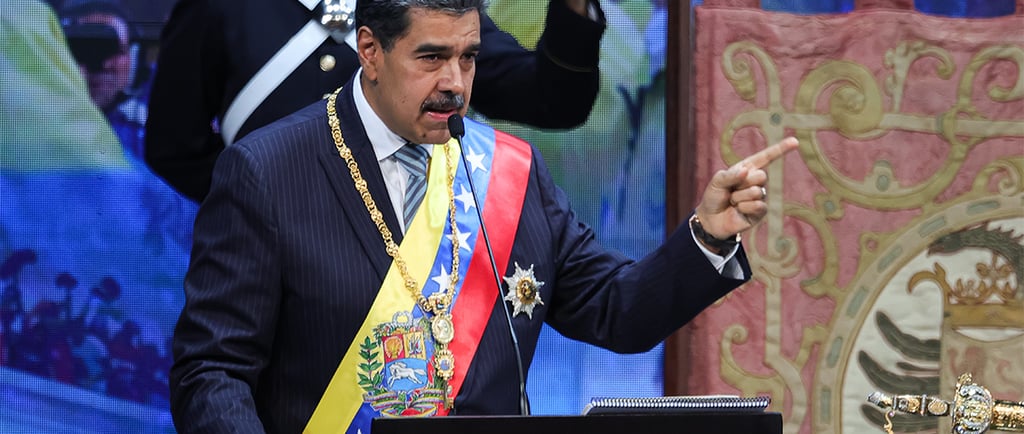
On January 3rd, 2026, Operation Absolute Resolve executed an incursion into Venezuela, which captured that country’s President Nicolás Maduro and his wife Cilia Flores for transport to the United States under indictment for conspiracy to traffic narcotics and other crimes. The operation utilized diverse assets of materiel and personnel to conduct a precision strike and exfiltration during which the only American casualty was… credulity in our judiciary.
It had been a while since the USA’s last snag-and-bag foray into Latin America. Back in 1989, the USA decided that it no longer liked Panama’s strongman president, General Manuel Noriega, whom for many years the Central Intelligence Agency (CIA) had armed and trained at its Academy of the Americas. The Academy was infamous for teaching Latin American despots how to suppress their ideological opponents so as to minimize disruptions in commerce. Noriega accordingly suppressed his opposition but got too melodramatic when in 1985 he had the opposition’s leader, Dr. Hugo Spadafora, decapitated and dumped in a mailbag on Panama’s border with Costa Rica. Noriega’s sinister flair had become a liability, and it did not help that he scrapped 1989’s electoral results which showed the opposition’s victory. The CIA finally whipped out the ol’ tried and trusted drug card and had a federal grand jury in Florida indict Noriega for conspiracy to traffic narcotics. President Noriega had in fact collaborated with U.S. authorities for the interdiction of narcotics, such as by notifying said authorities about sizable shipments. Granted, these were the shipments of rivals from those smugglers with whom Noriega had cultivated relationships (figures like the notorious drug lord Pablo Escobar from neighboring Colombia), but such relationships were to be expected given that narcotraffickers shared the CIA’s aversion to populist insurgency as disruptive to commerce.
Noriega was tried and convicted. He would never regain his freedom. After a sentence of seventeen years stateside, he was extradited in 2007 to France and imprisoned there after his conviction in absentia for money laundering and other crimes in 1999. In 2011 France ping-ponged Noriega back to Panama to begin yet another incarceration for crimes against his own citizens, during which incarceration Noriega died in 2017.
A Case All Its Own
Notwithstanding the parallelism of Noriega in Panama, Venezuela is markedly different as a case study. The USA has officially been on bad terms with Venezuela since former Lieutenant Colonel Hugo Chávez won its presidency in 1998. Chávez was a socialist hardliner in the vein of Che Guevara, and a friend to Cuba’s successive dictators of Fidel and Raúl Castro. He shared their disdain for “Yankee imperialism.” The USA reciprocated the sentiment and rushed to undermine Chávez via recognition of businessman Pedro Carmona, propped up as Venezuela’s new president during a military coup d’état in April 2002. The coup failed after just two days, and Chávez returned to the presidency. Carmona escaped to Colombia for asylum, where he resided for over twenty years before relocating to Spain.
Not having enough egg on its face, the USA rushed again in 2019 to recognize Juan Guaidó as Venezuela’s legitimate president. Guaidó was the Constituent Assembly’s leader (equivalent to the House of Representatives’ Speaker), and a majority of said Assembly approved Guaidó’s self-proclamation as President of the Republic, a position then occupied by Hugo Chávez’s hand-picked successor, Nicolás Maduro, a prominent leader of organized labor and member of the Partido Socialista Unido de Venezuela (PSUV). As with Carmona’s ephemeral coup seventeen years prior, the buzz around Guaidó quickly fizzled out, and he skedaddled to exile in Miami, Florida, before Maduro could have his throat slit.
Nor was the bad blood between the USA and Venezuela purely diplomatic. From 2004 to 2007, President Chávez sought greater nationalization of Venezuela’s industry in petroleum. He coerced foreign oil companies to sell at least 60% of their stock at dictated prices to Petróleos de Venezuela (PdV), the state-run company. The foreign companies had to sell or face expropriation. Firms like ExxonMobile and ConocoPhillips offshored as much of their operations as possible in their departure from Venezuela, but the government still expropriated assets collectively valued at $12 billion, as the International Chamber of Commerce (ICC) and the International Centre for the Settlement of Investment Disputes (ICSID) determined in judgments years later. Thus, the Venezuelan government’s pillage of oil companies with significant ownership in corporate and institutional shareholders domiciled stateside, was further cause for bad blood between the USA and Venezuela.
Venezuela’s domestic politics also became problematic for the USA in that it was becoming harder to gauge how “representative” the government was of its populace based on political and electoral instability. Even before Juan Guaidó’s legislative coup against the presidency, in May 2016 a nationwide movement to recall President Maduro collected 1.8 million petition signatures (nine times more than the required minimum). This was enough to trigger a secondary petition drive for a national referendum to recall Maduro. This would have necessitated three consecutive days of multitudinous demonstrations throughout Venezuela to collect the required four million signatures.
Maduro (who had won the presidency in 2013 by the slim margin of 1.6%) then took a page from the authoritarian playbook and declared a national emergency, which restricted travel and imposed a curfew. This made it practically impossible to collect the required signatures. The National Assembly rejected Maduro’s claimed emergency, and Maduro responded by pronouncing said Assembly illegitimate and advocating its dissolution. Trusting the National Assembly in 2016 to be more in touch with its constituents than President Maduro, the U.S. State Department decided to recognize 2016’s Assembly as Venezuela’s only representative government, a legal fiction strained to absurdity by 2026 since no assemblyman from 2016’s Assembly would still be in office without interim elections.
Contributing to the national institutions’ free fall was Venezuela’s plummeting socioeconomic health. Venezuela’s hyperinflation became Zimbabwean as Maduro printed the bolivar into worthlessness as gross domestic product (GDP) dropped by 17% in 2016. Crime became rampant, with murder and kidnappings widespread. Food centrally rationed by the socialist government became dangerously scarce, and a study commissioned by three Venezuelan universities concluded that the average citizen had lost 19 pounds (8.62 kg). In 2016, Caracans were so malnourished that they repeatedly broke into Caricuao Zoo to slaughter the animals on exhibit, probably a hidden mercy given that the national food shortage was also starving the animals. Against the worldwide decline in the price of oil, not even Venezuela’s abundance of that resource could offset the misery through which the country was living in mid-2016.
The telenovela of Venezuelan politics dragged on through 2017. In March, the Supreme Court loyal to Maduro, dissolved the National Assembly, predominantly loyal to the opposition. Even after the Supreme Court reversed the dissolution shortly thereafter, it engendered impassioned protests throughout the country. Maduro then announced that he would convene a new legislature, the Constituent Assembly, supposedly on a temporary basis to draft a new constitution, but critics feared that it would be permanent and packed with fervent Maduristas. Protests erupted nationwide, which quickly descended into violence during clashes with Madurista security forces. Over the course of said protests, at least 60 protesters were killed and some 1,200 grievously injured, including opposition leaders like Juan Requesenas.
On July 16th, 2017, the opposition organized a national referendum on the proposed Constituent Assembly, in which 7.2 million voters supposedly participated, resoundingly rejecting the new legislature. President Maduro denounced the referendum as unconstitutional and promoted the competing election for the new legislature on July 30th, 2017, which the opposition boycotted. According to Maduro, that election installed 545 members to the new Constituent Assembly. Scarcely two days afterwards, Madurista security forces raided the homes of opposition leaders Leopoldo López and Antonio Ledezma to black-bag them at night.
By October 2017, President Maduro’s crackdown had succeeded. The PSUV won the governorships of 18 out of 23 states in Venezuela, and Maduro felt confident enough to hold a presidential election in May 2018. Right on cue, the opposition (the loose coalition is called Mesa de la Unidad Democrática, or the “Democratic Unity Roundtable”) announced a boycott of said election, which of course ensured Maduro’s re-election until 2024. To this day, allegations persist that the regime infiltrates the opposition to steer it along a course which benefits the regime rather than hinders it, an allegation which has even been made about Venezuela’s fledging Libertarian Party (which hopefully is false!).
President Maduro sought a third term, to no one’s surprise. In advance, his Supreme Court disqualified the opposition in the person of María Corina Machado, who had been a member of the National Assembly in 2015. Despite the disqualification, Machado won the opposition’s primary by 93% but was excluded from the General Election. Instead opposition candidate Edmundo González was balloted as her proxy. The election concluded on July 29th, 2024, and both sides claimed victory. However, the National Electoral Council – another institution now beholden to the president – declared Maduro the winner, and lawfully or otherwise, that was the reality which took effect in the national government. Notwithstanding the vast popular support following Machado’s endorsement of González, it appeared that Venezuelans could not vote out the Madurista regime.
The Good, the Bad, and the Thugly
Operation Absolute Resolve has some points in its favor, some against, and some repercussions which will affect us all in ways now difficult to imagine. Central to any consideration about the operation and its consequences is what fate will befall Nicolás Maduro in American captivity.
In terms of Absolute Resolve’s execution on January 3rd itself, the operation appeared flawless from a civilian standpoint. No American servicemen were lost, and only six were wounded. The adversary suffered eighty casualties between servicemen and civilians, with minimal damage to property and infrastructure. Intelligence on the ground was able to pinpoint Maduro for extraction, so there was no raging gunfight through the streets to reach him or anything which would have exposed bystanders to undue harm. The operation relied on surprise, so the incursion was concluded in under thirty minutes. By contrast, the aforementioned campaign to capture President Manuel Noriega, dubbed Operation Just Cause, bombarded wide swaths of the capital Panama City over the course of a week, and led to hundreds of civilian casualties.
Nor was this – as far as we know thus far – a disruptive regime change. The USA may have learnt a bitter lesson twenty years earlier from toppling Saddam Hussein’s bad regime in Iraq only to have the worse regime of the Islamic State of Iraq and Syria (ISIS) fill the resultant void. In the present case, Maduro was immediately succeeded by his Vice-President Delcy Rodríguez, who appears to be fulfilling her role and has expressed willingness to cooperate with President Trump.
By way of that cooperation, certain oil companies may be admitted to Venezuela, but said admission is conditioned on their investment into Venezuela’s oil industry. As the industry now stands, it produces 1.5 million daily barrels fewer than it did fifteen years ago, since the equipment has deteriorated. Within Venezuela’s socialist economy, the PdV has had little incentive to maintain or upgrade the equipment, and foreign oil companies like Chevron (which remained in Venezuela after the coerced sales in 2007) had disincentive to renew the equipment lest the government expropriate the investments. It is therefore hoped that agreements can be reached to guarantee the needed investments in infrastructure and personnel (training) to improve the industry’s efficiency and safety.
Unfailingly some critics will think it crass that the USA topples Maduro and discussion comes to compensating oil companies, but a nobler principle is at work here. The companies which suffered expropriation (and “nationalization” without just compensation is expropriation and therefore theft) spent years litigating their claims before international organizations like the ICC and ICSID. Ultimately their claims were vindicated, but that just amounts to useless pieces of paper on which those judgments are printed. Venezuela thus far has refused to honor the judgments. Insofar as arrangements may be made to compensate those entities wronged by expropriation in 2007 – hopefully via a stake in modernizing the Venezuelan oil industry for more efficient and safer future production – this intervention may have secured for them a degree of compensation which international litigation never could.
More than lost profits’ recovery, the intervention has made possible the recovery of lost freedom for over a thousand political prisoners, with many more expected to receive amnesty. Some of these prisoners have languished for years in the regime’s cages, their only crime being a difference in conscience from what the Madurista regime desired. Far from fungible dollars and cents, these are people like María Oropeza from the state of Portuguesa, whom the regime kidnapped and caged for 551 harrowing days. These are sons, daughters, siblings and friends who may finally be able to rebuild the lives which their imprisonment shattered.
Of course, Maduro’s removal has come too late for some Venezuelans of similar conscience. Eight million Venezuelans fled the country over the course of Maduro’s presidency. Many such migrants were seeking prosperity abroad, the right to their own labor’s fruit without government seizing and misallocating it. Others were seeking safety from street crime and political violence which had become endemic under Maduro. Some sought a combination of both. Ronald Ojeda was one such migrant, a young Libertarian who took refuge in Chile, thinking that he had outrun the regime. Instead, Madurista agents tracked him to Chile and assassinated him. Maybe such tragedies will not be repeated now that Maduro has been removed, so that Venezuelans abroad can safely lead their lives according to their own conscience.
As for the bad in regards to Operation Absolute Resolve, one obvious question is, was this a one-off, or will the USA make a habit of removing sovereign heads of state who prove troublesome? Denmark’s prime minster Mette Frederiksen has opposed President Trump’s designs on Greenland, so will she be sleep-darted and awake on a C-17 Globemaster III bound for Guantanamo Bay? Glibness aside, the regime-altering power militarily to remove foreign heads of state currently vests in the president. Congress seemingly exercises no check beforehand on that power. Americans need to evaluate very carefully whether they are willing to tolerate this power’s exercise in the hands of other executives. Stated differently, will Trumpers endorse such power when President Gavin Newsom (hey, who knows what cats 2028 will drag in!) bonks Trump’s ally and Hungary’s president Viktor Orban on the bean and flies him to Gitmo? If not, then it may be time to re-consider the unitary executive.
As for the thugly… undoubtedly the worst dimension to this intervention has been the Department of Justice’s demands on the judiciary and credulity itself. Attorney General Pam “what about the Dow Jones” Bondi served an indictment on Maduro, charging him with twenty-five pages’ worth of fiction about trafficking guns and weapons. The only hitch is that the U.S. Coast Guard and the aptly renamed War Department have vaporized any evidence for these charges by destroying at least 35 Venezuelan boats, killing 135 possible witnesses in the persons of the crew and passengers. This was the series of seacraft supposedly originating from Venezuela which were obliterated in the Caribbean without the feeblest attempt at interception in the weeks leading up the incursion.
The “authority” for such wholesale destruction derives from President Trump’s proclamation of March 15th, 2025, which designates the Venezuelan criminal organization Tren de Aragua (TdA) as an enemy combatant. This allows the U.S. Armed Forces, absent due process, to neutralize its supposed operatives and instrumentalities. And since such operatives are enemy combatants without the status of uniformed foreign soldiers to whom Genevan Conventions apply, the War Department can even strafe survivors in the water from aircraft disguised as civilian, both war crimes in any other context.
That brings us to Nicolás Maduro qua defendant in a criminal case. Politically we already know that he was one of those “bad hombres” about whom Trump harped when a presidential candidate in 2016. More information may surface from Venezuela about Maduro’s repression there of rivals and critics, maybe even of embezzlement, yet no such details are actionable in federal court unless a nexus to U.S. persons or property can be instantiated. Maduro’s effective control over TdA, as an extensive criminal organization operating through prisons, will never be conclusively proven. Thus, federal adjudication of Maduro’s purely political misdeeds in his own jurisdiction, strains credulity in the American judiciary.
If you’ll pardon this article’s flippant title, I do not condone Maduro being shot or harmed in any way (Libertarians oppose capital punishment). The main point here is that against the stark choice of “disposing” of a foreign despot and irreparably compromising our judiciary, a well-respected judiciary is always preferable and essential to orderly society.
But don’t take my word for it. In a somewhat different context, U.S. Supreme Court Justice Robert Jackson stated the principle most eloquently when in 1945 he was asked to serve as the USA’s prosecutor in the Nuremberg trials of Nazi leadership. Whereas allied Soviet jurists’ only question initially was how quickly the defendants could be marched to a barn and sprayed with PPSh-41s, Jackson realized that if the judiciary was to judge the defendants’ actions, then the proceedings had to be authentic evaluations and not mere theatre for foregone political conclusions:
Jackson had attacked the cynics who had expected war crimes tribunals to act merely as extended weapons of war. “If we want to shoot Germans as a matter of policy… let it be done as such, but don’t hide the deed behind a court… It would bring the law into contempt… if mock trials were held with the verdict already decided… If these persons were to be executed, it should be as the result of a military or political decision.” (Nuremberg: The Last Battle, 1996, p. 3)
That said, for whatever remains of Nicolás Maduro’s natural life, surely the U.S. government has a cloistered garden in some compound which he could meditatively tend. Or maybe some military base’s army brats need a moustachioed Little League coach.