
Review of Dominic Frisby's "The Secret History of Gold"
Daniel Donnelly
3/23/20262 min read
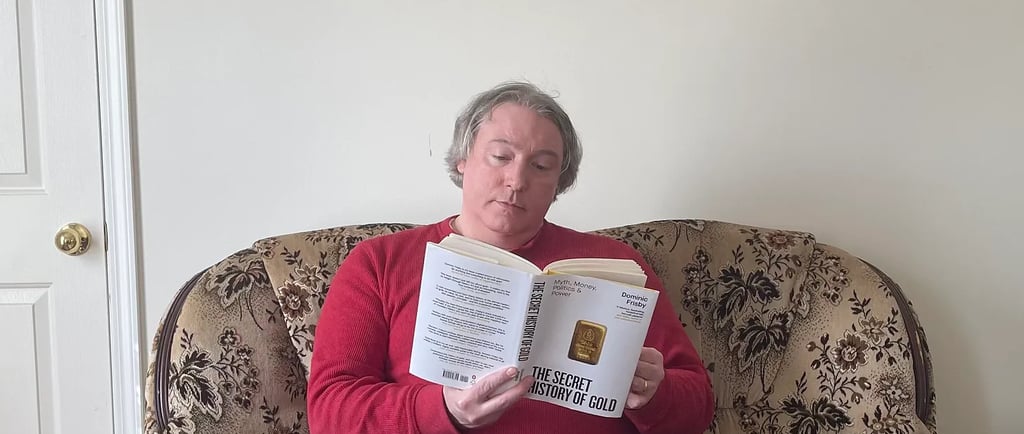
After water, no substance has influenced humanity more than gold. Gold has determined where we live, how we live, how we worship, how we trade, whom we love and whom we kill, amongst other uses. Not only has gold been central to humanity’s past, but it is crucial to our present and future in ways which may surprise you.
This is the gist of Dominic Frisby’s The Secret History of Gold: Myth, Money, Politics & Power (2025). Officially the book is not distributed in the United States until May 5th, 2026, but through EBay I was able to purchase a copy beforehand. This is the second book of Mr. Frisby which I read, the first being Daylight Robbery (2019), and this latest work impresses me no less. The multitalented Mr. Frisby – whose ukelele is even mightier than his pen – recounts gold’s role through the ages in a way which is refreshingly entertaining.
The reader first learns of gold’s prominent place in ancient spirituality, and how it still lingers as such in modern religious expression. One learns of gold’s use (and misuse) as currency through the ages, and even how none less than the scientific method’s founder, Sir Issac Newton, developed a clandestine fetish for the element when tasked with minting it into specie. Finally, one learns how gold is reshuffling the world order as blocs of ascendant countries hedge their bets with sizable gold reserves against the USA’s undisciplined manipulation of the fiat dollar.
Frisby draws from an extensive bibliography to supply ample quantification for his narrative, so at times the reader juggles figures like assay percentages, tonnage and currency conversions. There are even graphs and tables to track gold through the past and present, yet Frisby’s amusing tone makes the book read like one friend (albeit very erudite!) conversing with another over a pint.
The Secret History of Gold’s masterstroke is its pacing. Frisby steadily winches the reader up a roller coaster’s steep initial slope as the reader passively absorbs details about mining, alchemy, mythology, etc. When least expected, Frisby then drops you into the loop, where you’re gobsmacked by the reality of a fiat economy. Only then do you realize that life within an economy untethered to gold is like sprinting on a rapidly accelerating treadmill. It’s only a matter of time before your best labor and investments get you unceremoniously flung off. For anyone who recognizes worldwide stability and domestic affordability as pressing issues, gold must be seriously examined as a remedy, and this book does exactly that.
If you’re stateside and can wait until early May, then The Secret History of Gold: Myth, Money, Politics & Power will reward your patience. And if you’re impatient like me, maybe you can pay a friendly Brit to smuggle you out a copy beforehand.