
Appreciation and Austerity
On New York's upcoming school budget elections
Daniel Donnelly
5/9/20265 min leer
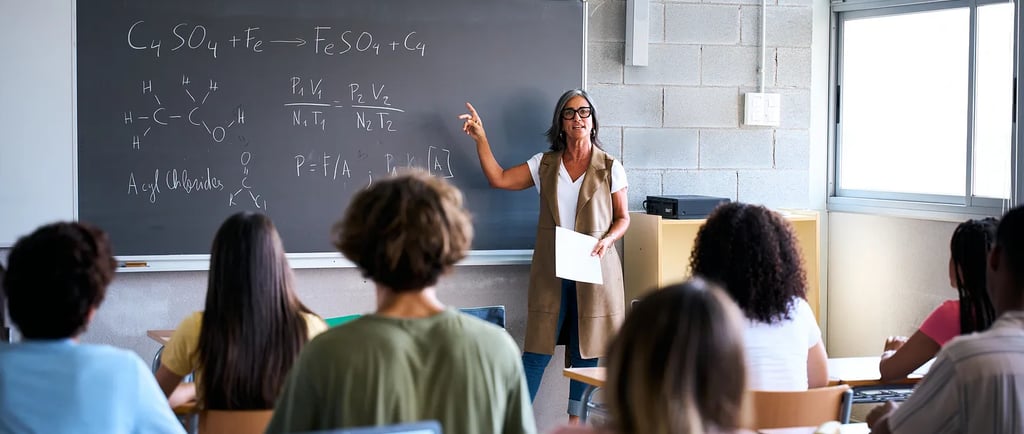
The National Education Association designates May 4th – May 8th as Teacher Appreciation Week. That is just before school districts throughout New York State vote for boards and especially budgets on Tuesday, May 19th, 2026. Surely the celebration of teachers shortly before the school district elections is an uncanny coincidence of the calendar.
Another coincidence peculiar to the weeks just before the school district elections is the posting on social media of classroom fundraisers. For anyone unfamiliar, classroom fundraisers are when teachers request money for supplies and activities within their classrooms or other areas under their management as teachers. Often such requests are directed to the students’ parents who will support out of direct self-interest, or community members who will support out of a sense of civic responsibility. Teacher Appreciation Week affords both motivations a chance to support educators on the front line.
Originally classroom fundraisers sought to purchase exhaustible supplies like pencils, stationery, crayons and finger-paints. That was soon upgraded to items of greater permanence, such as musical instruments. Nowadays it is commonplace to see posted fundraisers for fixtures like photographic printers, comfy swivel chairs and iMac computers. The fundraising has become more professionalized as well, complete with registries in which donors can “adopt a classroom” and support teachers by way of purchasing targeted items on the registry.
If not stated outright, two implications accompany these classroom fundraisers. The first is that the fundraisers are needed because the school district has no funding for these materials. The second is that in the absence of donor support, the teachers would have to pay for these supplies out of pocket. Especially when teachers post classroom fundraisers on social media during Teacher Appreciation Week right before school district votes, the conclusion towards which voters are drawn is that the district’s budget hike (and it is always a hike in New York) must be dutifully approved at the following week’s election.
Given only the foregoing information, voters would be pardoned for concluding that approval of the latest school budget hike will result in better equipped classrooms. From that conclusion, it is but a short logical step for voters to presume that more funding will result in better educational outcomes for the students. The deception here is that in practice, it is quite the opposite.
Taking first the presumption that another budgetary increase will result in better educational outcomes for the students, the data does not pan out. The gold standard in academic evaluation is the National Assessment of Educational Progress (NAEP), by which academic performance nationwide is tracked. This is what is called the “Nation’s Report Card.” The compiled statistics can be disaggregated by state, which avails curious data for New York in regards to public schools.
As of 2024, plotted on a scale of 500, New York ranks 234 against the national average of 237 for mathematics in grade four. For the same year, the state matches the national average of 271 for mathematics in grade eight. In the same year, New York matched the national average of 257 for reading at an eight-grade level, and the state tracked at 215 against the national average of 214 for reading in grade four. For eighth grade-science, in 2024 New York ranked at 150 on a scale of 300 against the national average of 153, which is insignificant difference. Longitudinally, these averages have largely held constant since 2017. In short, New York’s educational outcomes conform to the national averages.
The significant difference, however, is what New York spends to achieve these average results.
New York annually spends more per student than any other state in the union. It spends a staggering $36,293, which is nearly double the national average. Even more incredulously, this outlay trends upwards even though statewide enrollment in public school has plummeted overall by 320,000 students between 2014 – 2024. By comparison, neighboring Massachusetts outperforms New York on the NAEP, yet it only spends $21,855 per student. California spends slightly less at $20,855 per student, yet its results on the NAEP mirror those of New York. The foregoing data suggests that budgetary increases will not improve New York’s educational outcomes.
Cui Bono?
Having confronted the stark reality that New York’s educational outcomes are middling despite the overfunding, it is reasonable to question why the overfunding produces no better results. The earlier mention of Teacher Appreciation Week and classroom fundraisers may lead critics to suspect that teachers are to blame, but that is not the angle here.
To understand New York State’s educational results for public schools, we have to crunch a few more statistics, and thankfully we have some good bean-counters in both the national and state governments. According to the National Center for Education Statistics, the national average annual salary for teachers is $66,397 as of Fall 2022. with New York teachers earning on average $92,222. New York Principals fare better at $144,500 on average, as of 2020-2021.
Yet New York uniquely relies on administrators for its educational outcomes, which means that the New York State Education Department’s data is best for quantifying that reliance. Here are some spot checks around the state which showcase administrators’ costs to the educational system. According to the Personnel Master File Statistical Run for 2024-2025, in Albany City School District, the average administrator like a superintendent earns $185,138 to a classroom teacher at $87,133. In Buffalo City SD, the average administrator clears $164,328 to a frontline classroom teacher at $86,999. In Southern Tier’s Binghamton, $165,400 to $72,602. North Country’s Plattsburgh City, $183,692 to $71,699. Here in posh Dutchess County (population 299,999 with median income at 99K as of 2024), Hyde Park SD’s average administrator clears $203,167 to $94,323 for classroom teachers.
None of this includes New York City, which is administered by its Board of Education under a Commissioner, so the examined sample was limited to public school districts upstate.
There are some obvious reasons for the disparity in compensation for administrators and teachers. Administrators tend to have higher educational degrees and other valuable credentials. They tend to have greater seniority on the job, and more responsibility in the sense that theirs are the decisions about whether and when to declare school closures due to extreme weather. Finally, they are purportedly geared more towards the “bird’s eye” or strategic view of educating upcoming generations for the extant labor market.
That said, the foregoing remunerative disparities are considerable. The average upstate school administrator earns a full $100,000 more than a frontline classroom teacher. Against that disparity, 25% of high school graduates reach college unable to perform at the varsity level in English and mathematics, thereby requiring remediation which adds significant cost and time to college. As for the extant labor market, 84% of the 500 hiring managers surveyed in small, middle and large companies judge most high school graduates as underprepared for entry-level jobs, according to the U.S. Chamber of Commerce and the non-profit College Board. All this suggests that the taxpayers are not getting good bang for the buck when it comes to public school administrators.
The Road Ahead
As previously stated, blaming classroom teachers for New York’s suboptimal educational outcomes is not the angle here. In fact, when teachers publicize classroom fundraisers which claim or imply that there is a dearth in funding… believe them. Believe that there is either insufficient money after the administrators get their cut, or that the administrators simply will not approve whatever projects or supplies the frontline educators propose for their students. Believe the teachers and support their fundraisers as generously as your heart and purse allow. We greatly appreciate good teachers, yet direct and voluntaryist support is always preferable to monies extorted in taxes.
Then on Tuesday, May 19th, 2026, vote no for any proposed budget increase, no matter how modest.
For decades now, New York State has overfunded school districts, and the results are incommensurate with the spending. It is therefore time to vote some sanity into school budgets. It is time to teach administrators a valuable lesson which the rest of us mere mortals learn early:
Life’s not about always having more money… it’s about making the money you have stretch further.