
Pink Slips for Blue Shirts
Solutions for the TSA's slowdown
Daniel Donnelly
3/31/20264 min read
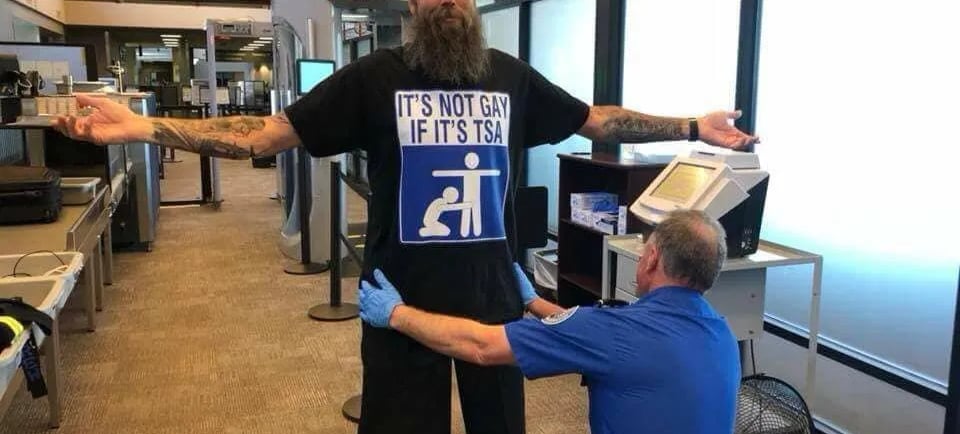
The Oxford Dictionary defines terrør1sm as the “unlawful use of violence and intimidation, especially against civilians, in the pursuit of political aims.” Typically this takes the form of violent events like b0mbs and hij@ckings to induce the affected civilians to demand from government the perpetrators’ desired objective.
The glaring disclaimer in the above definition is the term “unlawful” since it excludes governmental actions, which carry the presumption of lawfulness unless and until judicially invalidated. Such a loophole in the terminology is probably no accident since government on occasion engages in actions which approach this definition.
Of course, government is subtler than the average terrør1st. Instead of pressuring the citizenry through overt acts of violence, government has the wherewithal not to act, so that the citizenry feels pressured by a dearth in governmental action. We see this most concretely in the current slowdown of the Transportation Security Administration (TSA) on budgetary grounds.
The United States Congress has reached an impasse about appropriations to the TSA for the current fiscal year. In the balance hang remuneration for the TSA’s past and present work, and continuation of the agency’s current operations in airports around the USA. In fiscal year 2025, Congress appropriated $11.8 billion to the TSA. The amount demanded for the current year is at least as much, though probably a bit more since appropriations always creep upwards.
In protest of the congressional impasse, hundreds of TSA agents have simply quit in protest. Others appear to stage a slowdown with growing absenteeism by as much as 40% in major airports, a “blue flu” by blue-shirted agents similar to when police unions go on strike. As an expedient, President Trump has ordered the Immigration Customs Enforcement (ICE) to perform TSA’s duties at major airports, since that agency is now flush with cash. Reportedly the ICE agents interacting with the public at airports have been ordered to work unmasked so that the public and local law enforcement not confuse them with terrør1sts, an irony no doubt lost on ICE agents.
The net result of this budget crunch is that lines at airports grow longer and passengers grow wearier. This creates the ideal conditions for inducing the affected civilians to clamor for the TSA’s desired objective of more funding. This is not intimidation in the direct sense of threatening someone’s life with a firearm during a hijacking. Yet it intentionally and needlessly exerts pressure on someone by subjecting him to very adverse consequences, such as getting stranded in an unfamiliar city due to losing a connecting flight. The parade of dire headlines with accompanying photographs of passengers stranded at airports nearly write themselves. What such media coverage will never convey is that the TSA is the very reason we have these long lines in the first place!
After 9/11, twenty-two agencies were in full or partially combined to create the Department of Homeland Security (DHS). One agency which emerged whole cloth out of the national government’s reorganization is the TSA, originating in the Department of Transportation before subsumption into the DHS. It was thought then that there should be one agency “to rule them all” for airport security throughout the United States. Prior to that reorganization, each airline operated or employed its own security department which screened passengers for boarding. With the TSA’s advent, it took control of all pre-gate security, thereby bottlenecking passengers through one screening for access to the airports’ ticketed areas.
The conceit which inheres in any proposal for centralization is that administrators at the national level will foresee every contingency and forefend against it through nationwide protocols. Additionally proponents believe that a national agency will be more difficult to compromise than private and local agencies or companies. Experience, however, does not pan this out, especially in regards to the TSA.
In 2009, the TSA leaked its own internal protocols and security limitations, effectively “giving away the game” to any potential wrongdoers. In 2012, the Inspector General audited the TSA and determined its systemic inability to report, track and correct security breaches at airports. In 2023, the TSA’s secretive no-fly list was discovered on an unsecured server (whether such lists with unappealable entries should exist deserves an article on its own) and disseminated. The following year, a flaw in the TSA’s nationwide database was discovered whereby potential wrongdoers could designate some traveller a pilot and bypass security checkpoints. And in our modern era of Artificial Intelligence with all Big Data’s attendant risks, in good conscience one cannot overlook the TSA randomly singling out JetBlue’s passenger manifests and surrendering them absent subpoena in 2004 for the compilation of pre-flight threat assessments akin to China’s abhorrent social credit scoring.
In short, centralization leaves all your eggs in one basket. Compromise of the central agency affects everyone everywhere. That is why Congress should immediately abolish the TSA, with emergency funding granted only until airports phase in their own private security (certainly no longer than six months).
If airports (if not airlines) were to provide their own security, there would be a vested interest in keeping travellers safe and lines short. Undoubtedly national standards will arise, and we will have a decentralized feedback loop of local best practices. Travellers in turn will gravitate towards those airports or airlines which handle security more effectively and efficiently, thereby rewarding better protocols whilst punishing laggards. Far from a radical proposal, this is how the major airport of San Francisco (SFO) operates, having decided against deploying TSA.
Abolishment of the TSA is what should happen, but a sinking feeling tells me that the situation will not resolve so heroically. The TSA’s national crunch on airline passengers will likely drive the passengers en masse to contact their representatives and demand emergency funding.
Whereas in the civilian world when two parties reach an impasse in negotiations, each side compromises to conclude a deal in which each gets half of what it originally demanded. Dr. Ron Paul (U.S. Representative from Texas for 22 years, Libertarian presidential nominee in 1988) famously described a “Washington compromise” as a deal concluded by each side simply doubling its demands so that both walk away with twice as much… as the taxpayer limbs away twice as poor.
Thus, Congress will not think to halt appropriations to the military for the undeclared war in Iran on which President Donald Trump never campaigned (which is burning through $2 billion daily). Nor will it countenance major cuts from other agencies. Instead, this crisis will inevitably result in the Congress crudely creating money out of nothing, thereby inflating the money supply and debasing your purchasing power and savings.
There is no better time than the present to leave the Transportation Security Administration permanently grounded!