
Review of Mike ter Maat's "Broken"
Review of Dr. Mike ter Maat's latest book
BOOK REVIEW
Daniel Donnelly
5/26/20262 min read
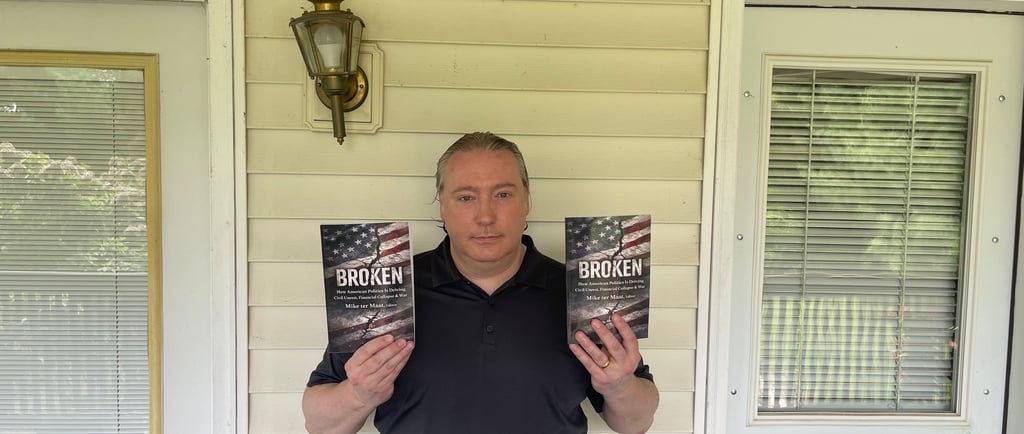
No observer of modern American politics would remark that there is nothing to be improved. Though the United States quickly approaches its 250th birthday, no citizen opines that our governance is the pinnacle of perfection. Every conscious American realizes that something has gone terribly wrong in our Republic. The only remaining question is whether the eventual if not imminent fall can be cushioned, and if not, how best to brace ourselves for the uncertainties to follow.
This is the topic of Broken: How American Politics Is Driving Civil Unrest, Financial Collapse & War (2026), edited by Mike ter Maat. This is a collection of twelve essays and one transcripted interview, each addressing different aspects of American politics and governance. The contributing essayists are all distinguished experts in their respective fields, such as tax policy, immigration, economics, finance, municipal administration, foreign policy and national security. By way of this publication, Dr. Mike ter Maat showcases a faction within the Republican Party called Liberty Republicans, whose approach to these pressing issues of modern governance diverges from their party’s orthodoxy.
All contributions in this collection are engaging and worthy, but a few stood out for me. Former U.S. Comptroller General and U.S. Government Accountability Office (GAO) director David Walker authors “Restoring Congressional Fiscal Responsibility,” which demystifies the USA’s finances by the simple trick of uniformly removing eight zeros from the sums involved. Thereby he demonstrates that it is a matter of mere time before the USA’s profligacy will inevitably close the last lifelines of credit sustaining us. Mark Moses highlights municipalities’ exposure in the deck of cards which is the USA’s financial system, since municipalities – unlike the national government – cannot simply “print” their way out of fiscal constraints by inflating the currency. Dr. Siri Terjesen explains how ballooning student debt impacts national finances, especially since many Americans incur life-altering educational debt disproportionate to the degrees’ remunerative potential. Jeffrey L. Degner’s libertarian essay traces taxation’s normalization to political depredation from one constituency to another. Finally, retired U.S. Marine Tim Lewis analogizes American foreign policy’s “nation-building” to a gymnasium which can feature all the latest and greatest exercise equipment but which will have no appreciable effect on the gym member who does not routinely and vigorously use it.
Perhaps the most stirring essay is Dr. Peter Earle’s “What a US Debt Default Would Look Like.” As a former trader and analyst of securities, Earle outlines the points of collapse when the USA (ineludibly unless drastic countermeasures are taken) hits rock bottom, and how that will play out through politics and the media. The hectic crises of 2008 and 2011 will seem like a cakewalk compared to the reckoning on its way when domestic and foreign markets finally realize the mathematical impossibility of the national government ever redeeming its hideous overextensions. Beads of cold sweat trickled down my back as I read this essay, realizing Earle’s tactful omission of the pensioners who will suddenly discover en masse that their Roth IRAs and 401(k)s with pay-outs in U.S. dollars will be utterly worthless just before plunging from their high-rise apartment windows.
Yet there is time to close the window. There is still time to turn around the ship of state, and return our Republic to solvency and responsibility. Editor Mike ter Maat curates these essays because they also advance practical solutions to the issues which our country confronts. The future’s dire challenges will never be overcome by the same orthodoxy which got us into such challenges. This is why it is time to consider new, out-of-the-box approaches if we are to prove deserving of the Republic which the Founders solemnly entrusted to us, 250 years ago.