
Scorn and Sympathy
On the Sovereign Citizen Movement
SOCIETY
Daniel Donnelly
9/24/202613 min read


Everyone wants a get out of jail free card, as in the boardgame of Monopoly. Speeding, squatting, criminal contempt of injunctions… just flash the card and all consequences instantly disappear! Everyone also wants what video gaming calls an “unlimited money hack,” whereby your funds are inexhaustible since you merely file a demand for millions of dollars from someone and he promptly pays you in full. Thankfully a loose association of individuals called Sovereign Citizens has been developing the card and the hack. The only catch is that both are just as likely to land you in jail and leave you broke.
Ideology
Since the 1970s, strange legal theories have circulated and percolated within certain communities like a drunk game of telephone. The theories convolute and tangle, but fair attempt will be made to present them accurately. One theory posits that since ratification of the Fourteenth Amendment to the United States Constitution in 1868, there has been a bifurcation in the relationship between citizens and the national government. Citizens who enjoy all the U.S. Constitution’s rights are considered “Sovereigns.” (¶ 4, p. 2) Those who have accepted federal benefits have traded away their inherent Sovereignty to become the lesser “federal citizens.” This bifurcation, as goes the theory, changes the rights and duties of the respective classes of citizens. The lesser federal citizens must comply with all laws and regulations, whilst the Sovereigns are exempt from such compliance.
Nevertheless, Sovereigns dismiss all constitutional law post-1868 as invalid, recognizing common law as the only legitimate jurisprudence. Common law is the legal tradition inherited from the British which informs Americans’ understanding of judicial precedent and interpretation. It contrasts with positivist law, consisting of the statutes which Congress and state legislatures promulgate. (¶1, p. 31) Positivist law in a sense displaces common law since a statute may define a crime differently than the common law used to define it, which means that for some offenses, there may be a lower evidentiary threshold for conviction. A well-known example of this is statutory rape, which eliminates common law’s element of consent to ask only whether sex occurred between two persons, and whether one of them at the time was under the age of consent. Notwithstanding, jurists still use common law to “fill in the blanks” left by positivist law, yet those blanks are ever fewer since American legislatures have been busy codifying laws for over 300 years.
Sovereigns do not pretend that common law predominates in American jurisprudence. They realize that it has lost sway in government. In its place, Sovereigns contend that government (at the federal, state and local levels) operates under admiralty and maritime law. (§ IId) Sovereigns substantiate this claim by pointing to the American flag which hangs in courtrooms, usually bordered by golden tassels. On account of government’s abandonment of common law in purported favor of admiralty and maritime law, modern government is irremediably compromised. (¶ 4) This renders government wholly illegitimate and designates Sovereigns as the true guardians of the freedoms which government was instituted to protect, according to the Sovereigns.
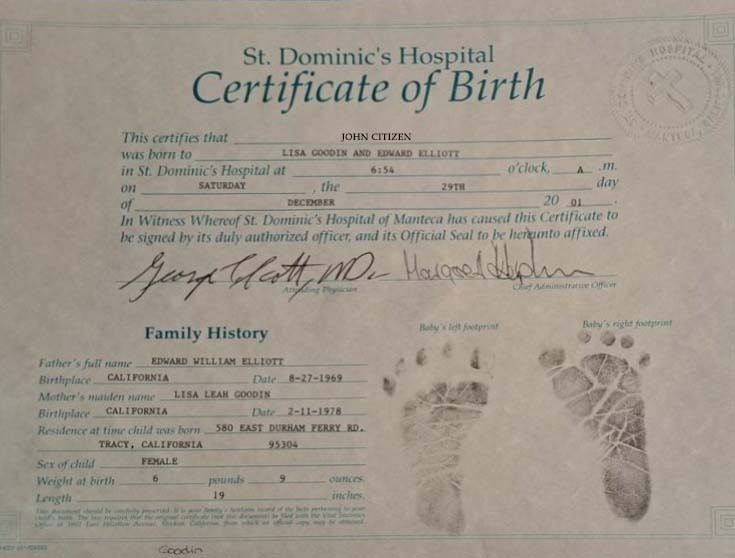
Though never under obligation for interaction, Sovereigns may choose interaction with government. This they do through a legal identity which they term the “strawman.” The strawman refers to legal personhood as viewed from and by government. (p. 5) This typically starts with a certificate of live birth which a hospital issues (typically the infant’s inked footprint will mark this certificate), from which government later issues a formal birth certificate. The formal birth certificate records the infant’s name in capitalized letters, which Sovereigns interpret as creation of a strawman.
For those occasions when a Sovereign interacts with government through his strawman, he does so within the context of the Uniform Commercial Code (UCC). An association of jurists called the American Legal Institute compiled and recommended the UCC in 1951 to harmonize disparate state laws governing the commerce of commodities (as opposed to services). The UCC covers all aspects of such commerce, like delivery, insurance, warehousing and finance. Every state eventually adopted the UCC in whole or part, as well as foreign countries. Though it is more positivist than common law, a Sovereign’s strawman often resorts to the UCC to stake claims against government, as will be detailed below.
Another strand of Sovereign citizen theory reaches even farther into history to take the year of 1787 as its point of departure. It was in this year that the newly formed United States of America executed a treaty with the emirate of Morocco. The treaty only authorized the USA to trade with Morocco, but a branch of Sovereigns called the Moorish Nation believe that the treaty recognized all Moroccan subjects as equal in sovereignty to the USA. Unsurprisingly, this means that their modern descendants in the USA are exempt from all American laws.
The Moorish Nation is the most organized of Sovereign communities, with a hierarchy and temples throughout the USA in places like Newark NJ, Cleveland OH, Dallas TX, and the grand temple in Chicago IL. Membership in the Moorish nation is exclusive to Afro-Americans, which is ironic given that this demographic mainly descends from the sub-Sahara and western Africa rather than Morocco. The Moorish Nation’s membership grew so vast that it engendered split-offs like the Washitaw Nation, who claim sovereignty due to descent from Amerindians “not subject to U.S. jurisdiction.”
Abetting and further obfuscating Sovereign conceptions, Sovereigns believe that since the national government abandoned the gold standard in 1933, the Social Security Administration established in 1935 pledges social security numbers (SSNs) as collateral to foreign countries and entities which lend money to the national government. Thus, to the extent that a person transacts with government or others using the SSN, one day foreign creditors could pursue him in propria persona for repayment of the national government’s loans, or so goes the belief. Another variation is that the U.S. Treasury maintains secretive interest-bearing accounts corresponding to every citizen which derive from such foreign loans, and through specialized filings, the corresponding citizens can claim or “redeem” those funds for their personal benefit.
Far from a uniquely American phenomenon, Sovereign Citizenship exists in many countries. Mostly these are countries in the Anglosphere, with strong common law heritage like the the United Kingdom, Canada, Australia and New Zealand, but proponents have popped up in countries like Germany and Italy. There are even self-professed Sovereign Citizens in Russia, who aver that the Soviet Union never really dissolved! (Pometto, 2020, pp. 51-52)
If all this Sovereign ideology makes no sense to you, that just means you haven’t yet guzzled enough José Cuervo! The dots begin to blur together when you’re hopelessly blotto.
Straddling the Fence
Were Sovereigns to retreat from modern society and become ascetics akin to the Amish – concentrated in one region, transacting with outsiders only as necessary – that would be understandable. But the Sovereigns are everywhere, and many insist on interacting with mainstream society even though Sovereigns know that society shares none of Sovereigns’ concepts about law and commerce. In this way, Sovereigns straddle the fence between the reality in which everyone exists, and the utopia which exists in Sovereigns’ mind alone.
Thus on public roadways, a Sovereign may drive a car. He describes it as “travelling pursuant 18 U.S.C. § 31,” but to anyone else’s eyes, he is operating a motor vehicle even though he is unlicensed, the car is unregistered, unplated, uninspected, and of greatest public concern, uninsured. The statute which he cites has zero bearing on the situation since it is a federal criminal code inapplicable to the myriad state laws he is violating. Nevertheless, just as that legal citation is fabricated, the Sovereign may produce fabricated documentation if the police demand it. His car may already bear an improvised license plate and homemade stickers for registration and inspection (often the reason for which the police initiate the traffic stop). Not forgeries of official indicia, but decals which authenticate issuance from the authority of… the Sovereign Citizen himself. The Sovereign may also present similarly contrived documentation for registration and insurance, like a certificate of a high bank balance as if to say, “in case of accident, I’m good for it!”
Discontent to limit their ideology to public roadways, some Sovereigns will take it to court by way of vexatious litigation. Such litigation may be directed at governmental officers like policemen, mayors and judges, who in the course of their official duties, crossed a Sovereign in some way. Naturally, such officers enjoy some immunity from personal suits to insulate them from disgruntled citizens. To circumvent such immunity, Sovereigns instead file spurious liens against these officers’ private property, asserting that the officers owe tens of thousands of dollars to the Sovereign for having consumed his time in some way. The public clerks (stationed at the courts, townships, counties, etc.) usually are required to accept any filing without discrimination on merits, which means that the vexatious liens may embargo title to the officers’ private property and affect their credit worthiness, regardless of the claims’ justiciability against the officers.
Most confusingly, Sovereigns straddle the fence between outright rejection of taxation as personally inapplicable and filing claims on tax funds. One instructive case was that of Marcel Walton, Grand Sheik of the Moorish Nation in Chicago. In 2017, Walton was convicted of filing tax returns with the Internal Revenue Service (IRS) demanding refunds of $3.2 million. Walton had demanded these refunds as rent for government’s use of realty which the Moorish Nation claims. Walton knew that the Moorish Nation possesses no title to the realty, which made the tax returns all fraudulent.
The worst cases of disconnect between Sovereigns and government play out in roadside police investigations and courtroom appearances. There are hundreds of such interactions on video, and though some viewers are attracted to the videos’ sensationalism, the videos have no value for either education or entertainment since you will learn nothing about law and the outcomes are boringly predictable. The interactions begin and conclude much the same in all instances.
If it is a roadside police investigation, the Sovereign begins by questioning the detention. He either refuses identification and travel documentation (e.g., insurance and registration) or produces homemade documentation which only confuses the police. After patience is exhausted, the police decide to arrest the Sovereign, which sometimes occasions an unprofitable and felonious scuffle beforehand. The conclusion never varies; the Sovereign winds up handcuffed and charged, having turned the mole hill of a minor traffic infraction into a mountain of legal consequences.
If it is a courtroom interaction, the Sovereign (who never retains attorneys since they don’t know the real common law!) plays coy with identification so as not to implicate his strawman. He claims that he is not the named defendant but rather said defendant’s representative. The judge requests this representative’s name since the record must reflect who appeared on the defendant’s behalf, but the Sovereign demures and counters that the court lacks jurisdiction to hear the case since it operates under admiralty law (meanwhile that tasseled flag on a pole in the courtroom’s corner has no more bearing on the court’s jurisprudence than the judge’s stapler!). He identifies himself as “Without Prejudice UCC § 1-308.” This commercial provision titled, Performance or Acceptance Under Reservation of Rights, reserves someone’s rights when signing a contract for commodities if the contractual language could possibly affect those rights, but it has absolutely no relation to a litigant’s appearance in court.
The Sovereign unsolicited rattles off precedent which he deems persuasive to his position, but the cases are thematically inapplicable, ancient, foreign, and fatally, he references obiter dicta rather than the cases’ holdings. A judicial case’s value is in its holding in the way a joke’s value is in its punchline; everything up to that point is the joke’s set-up, roughly corresponding to dicta in case law. When the judge orders silence, the Sovereign claims violation of his right to free speech under the First Amendment (suddenly he approves of the U.S. Constitution!). As dockets are clogged with all the other cases to be heard that day, the judge’s patience lapses sooner or later and he rules against the Sovereign, often jailing the Sovereign for contempt of court after having wasted everyone’s time with frivolous arguments.
It never goes any other way. Sovereigns always talk themselves in deeper holes by trying to fight the system using rules of their own invention. More plainly, Sovereigns worsen their outcomes by thinking themselves above the law.
Tempering the Alarm
Much of the literature about Sovereign Citizens comes from government or is heavily influenced by governmental data and funding. Government tends to paint Sovereigns as implacable terrorists. The literature emphasizes violent and even deadly encounters between police and suspects who professed Sovereign ideology. Such alarmism, however, must be tempered against the bigger picture.
According to the Federal Bureau of Investigations’ National Incident-Based Reporting System (NIBRS), 53 police officers were feloniously killed in the line of duty, with 90,178 assaulted between 2024-2025. Ideally no suspect should fight and harm police officers effectuating lawful arrest, but Sovereigns had little to do with these incidents. These incidents occurred with traffickers of drugs or humans, desperate recidivists, persons agitated during investigations into domestic violence, persons suffering intoxication or psychopathy, etc. Being that the highest reliable estimates suggest that Sovereigns number maybe 500,000 nationwide (§ 1.1), Sovereign violence against police is statistically insignificant.
The literature about Sovereigns reasons that their anti-government rhetoric and ideology predisposes them to violence against government, but the literature relies on mere supposition since the statistics do not justify the alarmism. Readers can perceive this “stretch” to conclusions in literature about Sovereigns by the attempt to broad-brush them with the label of racism, which instantly discredits the person or group so labelled. Here is an excerpt from the Southern Poverty Law Center’s article about Sovereigns:
The roots of the movement are racist and antisemitic. It was founded in 1971 by William Potter Gale, a former member of the John Birch Society who formed a group of antigovernment Christian Identity adherents who mistrusted state and federal officials. They believed that non-white people were not human, and that Jewish people were engaged in a satanic plot to take over the world. (¶ 13)
Stated explicitly, the SPLC is telling the reader that since the ideology’s precursors were racists (and white Christian racists, which apparently is twice as blameworthy!), those who profess Sovereign ideology fifty-five years later must all be. But then again, for nearly a decade the SPLC has been subsidizing the very racist ideologues it hyperbolically demonizes. For all we know, we’re just a few news cycles away from discovering that the SPLC has also been underwriting Sovereigns!
None of this minimizes the fact that Sovereign individuals have contemptibly perpetrated violence against police. It merely quantifies the threat to realistic proportions. Though government finds Sovereign Citizens obnoxious, most are harmless, and crucially, all are ineffective at reversing freedom’s loss to government.
Guilt’s Gradient
Within any sizable association of people, there will be variation in intentions amongst associates. The same holds true for Sovereign Citizens. Some people plunge down the Sovereign rabbit hole in a genuine quest for truth about law and civics. Others only see a means to easy gelt and attention for themselves. In this way, Sovereigns can be plotted along a gradient depending on their culpability.
Lowest along this gradient are those inducted into Sovereign ideology during sincere research into legal matters. This may be someone undergoing a contested divorce who seeks answers about jurisdiction, or someone facing foreclosure who is desperate for solutions to taxation. They attend a support group in their quest for answers, and someone hands them a Sovereign pamphlet explaining away their troubles by asserting that government exerts no power over them. Their schooling may be limited, so prolix Sovereign proclamations convince them that the Sovereigns have the right of it. We can condemn such people as gullible – and it is certainly unreasonable for these adults to believe that millions of other Americans willingly relinquish their autonomy to government – but it must be recognized that their culpability is the lowest along the gradient.
Higher along the gradient are those who scienter spew Sovereign nonsense on official filings or declaim it during oral argument at judicial hearings. These Sovereigns know that their arguments are bogus, but they waste everyone’s time nonetheless. Deep down, these Sovereigns just want to be the center of attention for a moment – to have a whole courtroom indulging their legalese bloviations amounting to gibberish. These Sovereigns don’t practice law so much as perform it for an audience, and they are satisfied to command onlookers’ attention, even if that is when bailiffs escort these Sovereigns handcuffed out of the courtroom for a stint in jail under criminal contempt.
Highest along the gradient are those who market “common law courses,” “Sovereign seminars” and “Citizen Handbooks” touting legal theories and practices which the proponents know are pure bunk. It is one thing for a Sovereign to make a fool of himself in dealings with government, but it is much worse for a Sovereign to induce others to do the same with a siren song which leads them into untold legal complications. Especially given the lucre these Sovereign gurus make on the sale of courses and materials – for some of which they charge thousands of dollars – these Sovereign are capitalizing on a vulnerable segment of the population, and in the process, mass producing Sovereigns to perpetuate these legal delusions.
Sympathy
There is some overlap between Sovereigns and Libertarians, in a way. Sovereigns denounce all government as illegitimate, whilst Libertarians denounce as such only certain governmental functions, like taxation on income and property of any kind. For this reason, Sovereigns and Libertarians occasionally cross paths in our activism, so over the last twenty years I have been acquainted with Sovereigns. As I would tell (and have told!) any Sovereign is that the Sovereign objective of reducing government’s power over Americans is honorable, but Sovereigns’ way of achieving this is extremely counterproductive, to put it mildly.
A wistful nostalgia characterizes Sovereign ideology in its pining for the common law of yore and the days when government was not a fixture in every citizen’s life, as government has grown to be. Next week the USA celebrates 250 years since the Declaration of Independence, a revolution sparked by a 3¢ tax on tea and intrusive Writs of Assistance whereby crown officers could barge unannounced into American homes, workplaces and ships to seize anything they wanted. Fast forward to today, Americans spend the first four months of every year working exclusively to fulfill their tax burden to federal, state and local government. And the Writs of Assistance were child’s play; now at a keystroke government warrantlessly siphons all your digital records and uses your own electronics to snoop on you. It is easy to see why Sovereigns long for the early Republic, when government better understood its role as servant to the citizenry, and not the other way around.
Sovereigns’ commitment to their cause is also commendable. Though much less than attorneys, Sovereigns avidly study the law to a degree far surpassing the lay public. Consider for a moment that if someone reads the U.S. Constitution in its entirety – preamble, the seven articles and twenty-seven amendments – he has done more than roughly 50% of the lay public. If he also reads his state’s whole constitution, he has done more than roughly 90% of the lay public. Such diligent study is commonplace for many Sovereigns. Problems arise, however, because the Sovereign perspective on the law is erroneous.
The study of law is about discerning parties’ relationships within given strictures. Specifically, it is about understanding how power is exercised in certain contexts. Law requires humility in its students to observe objectively how authority manifests across different situations. If a Sovereign reads law with the perspective that he is inviolate above everything and everyone, then he will never glean the valuable insight of how law can be successfully utilized to safeguard interests.
This constructive criticism is fondly offered to Sovereign Citizens. Sovereign methods are woefully ineffective, but the Sovereign true north of confining government to its proper, limited role is praiseworthy. There may be no helping Sovereigns who are higher along the gradient of culpability – and indeed, association with unrehabilitated hucksters is inadvisable – but for novices in the Sovereign movement, please turn back now, for that road only leads to disappointment.